


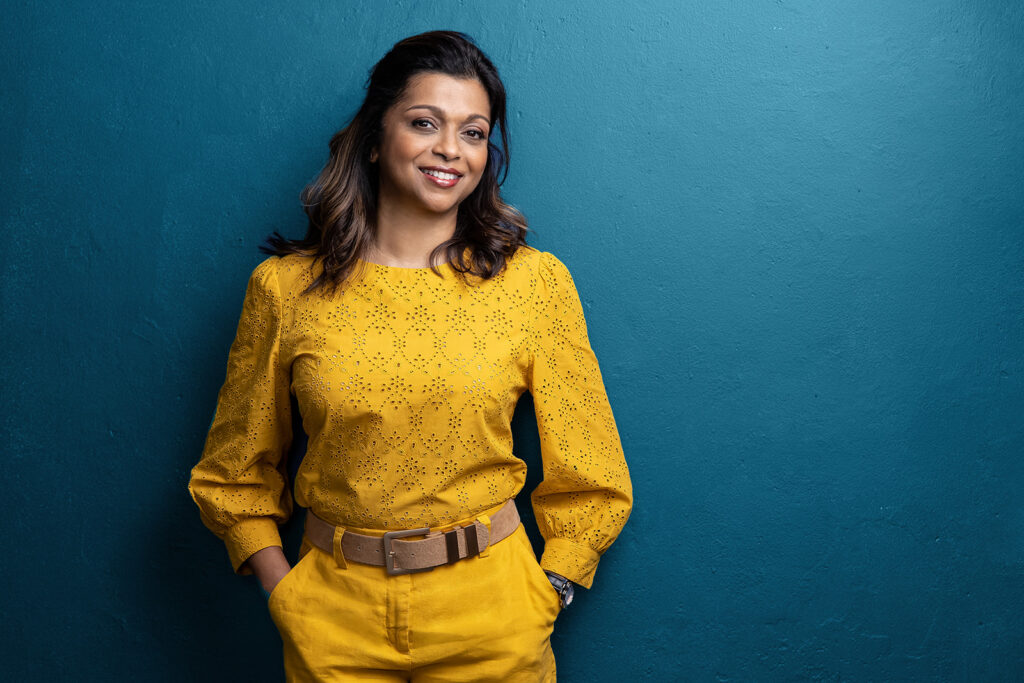


A fun corporate headshot is a professional headshot with the personality turned up. It still has to look professional, because whoever’s looking at it is still deciding whether to trust you.
The personality comes from expression, colour, pose, setting and framing. The parts that make a headshot work stay exactly where they are: flattering light, sharp eyes, a clean crop and a face that matches the one that walks into the meeting.
Most people assume “fun” means a prop, a pulled face or a crop from the Christmas party photos. It doesn’t.
Pick one element to carry the personality and keep everything else standard.
What makes a corporate headshot fun?
Personality shown through choices, not gimmicks.
A real laugh, a colour behind you, a relaxed pose, your office softly blurred in the background or a looser frame. Any one of those moves a headshot away from the stiff grey-backdrop shot without making it casual, because modern doesn’t mean casual.
What fun isn’t is a novelty prop, a silly face or a holiday snap cropped down to a square. Those get one laugh, then sit on your LinkedIn profile for two years while you pitch for serious work.
It isn’t an acting headshot either. Corporate and acting headshots do different jobs, and borrowing one’s rules for the other rarely helps.
The joke wears off. The photo doesn’t.
Can a fun headshot still look professional?
Yes, as long as the basics hold.
That means flattering light, eyes in sharp focus, a clean crop and retouching that tidies stray hairs, shine and creases without changing your face. Get those right and a colour backdrop or a laugh reads as confidence. Get them wrong and no amount of personality saves it.
The useful test is simple: would your clients trust the person in this photo with their money, their matter or their project?
For an agency, a founder or a consultant with a personal brand, the answer is usually yes. A senior lawyer, an auditor or a construction firm pitching for government work is in a different spot. Partner profiles and tenders are read by people who expect the standard version, so it pays to have both.
Match the fun to the reader, not the trend.
Creative headshot ideas that still work at work
Seven ideas, roughly from the subtlest to the boldest. Most people only need one or two.
A real laugh instead of a polite smile

This is the easiest change, and the one people underestimate. The version that works is genuine warmth, the moment just after something actually amused you, not a full belly laugh with your eyes squeezed shut.
It’s the one change that works in most roles, because it’s warmth rather than a gimmick.
Most of the difference between an average headshot and a good one is expression, and that’s much easier with someone guiding you, which is why we direct it rather than leave it to chance. Our guide to smiling in a headshot goes further.
A colour backdrop, or your brand colour

Decide where the colour lives. It can go on the wall or on you.
Swap the grey for a muted teal or dusty blue and keep your clothes simple. It adds personality without looking informal. A brand colour can work as a backdrop too, as long as it doesn’t fight with your skin tone.
Or move the colour to you: a jacket, top or scarf that echoes your brand palette, with a background chosen to match the website the photo will sit on. That suits founders and personal brands, where the photo and the logo live side by side. Get the shade close rather than exact. Nobody will hold a swatch up to your jumper, but they’ll notice if your teal clashes with the website’s.
The rule: if the background is the colour, the outfit shouldn’t be. Our guide to headshot background colours covers the ones that age well.
A relaxed pose

Leaning in, sitting on a statement chair, even hands behind the head. Our creative and editorial portraits page has two examples that do exactly this: a relaxed portrait on a bright orange chair against a clean office backdrop, and a black-and-white portrait with hands behind the head against a clean dark background.
It suits people who are relaxed in real life. If you’d never sit like that in a meeting, it’ll look borrowed.
When the pose is doing the work, keep everything else simple. One loud element is plenty.
Your workplace in the background

You’re sharp and the office is soft behind you. The look is often called environmental office blur, and it tells people where you work without a word of copy. It suits founders, tech teams and anyone proud of their space. One portrait in our portfolio does it in black and white: a genuine smile in front of a softly blurred office.
Tidy up first. Blur hides detail, but it won’t hide a stack of delivery boxes.
High-contrast black and white

It’s one of the modern styles that holds up well. It suits creatives, authors and speakers, and black and white often looks more considered in an event program next to other speakers’ photos.
Mention it when you book so it’s part of the plan, not an afterthought.
A looser, editorial frame

This means waist up, three-quarter or landscape rather than a tight head-and-shoulders crop. It leaves room for posture and a bit of the setting, and a wider version gives a website banner space for text. It suits about pages, press releases and speaker profiles. A tight headshot still does LinkedIn better, which is the main difference between a headshot and an editorial portrait.
Shoot it alongside your usual headshot, not instead of it.
A prop from your work

Only if it belongs to your profession, and only if it’s small enough that your face stays the focus: a designer’s sketchbook, say, or a podcaster’s headphones. Check with us first.
A prop that’s too big, too shiny or too clever ends up being the headshot, with you as its stand.
How do you make fun headshots work for a whole team?

Share the fun element and keep the setup identical.
Pick one idea for everyone, such as a dusty blue background or a relaxed second frame. Then hold everything else fixed: the same light, background, crop and camera height. Each person brings their own expression, and that’s where the personality comes from.
The alternative is ten people choosing ten ideas, and a team page that looks like ten small businesses sharing one website. Mixed, unmatched sets are the most common problem we’re called in to fix.
When we photograph headshots for companies, the setup goes into a Style Guide on file, recording the background, lighting, distance, camera height and crop. A new starter who joins months later gets the same look, laugh included if they’ve got one, so decide the fun element before the first person sits down.
For a group shot, a directed team portrait does more than a line-up. Composition, posture and expressions are directed and the energy is guided, so you get group hero shots with personality instead of a row of people waiting for a bus.
Consistent first. Then fun.
Getting your Sydney team photographed?
We run "Staff Headshot Days" - 30+ people, one consistent look, minimal disruption.
Should you get a fun headshot and a formal one?
Yes, and we can shoot both in one session.
Wear your jacket for the formal frame and take it off for the relaxed one, in the same light against the same background, so the two sit together. Change the expression and pose between them and you’ve got two photos that clearly belong to the same person on the same day.
Use the formal one for the website, tenders and anywhere a conservative client will see you first. Use the relaxed one for LinkedIn, a speaker bio or the team page. Our post on formal vs casual headshots covers which goes where.
Two frames, one sitting, no clash.
Want an exact price?
Book a free 15-minute consult – no obligation, just a clear quote and a plan.
How do you plan a creative headshot session?
Start with where the photo will live.
A LinkedIn circle, a website banner and a press page all want different crops, and a banner usually needs a wider frame with room for text. Decide that first and everything else gets easier.
- Describe the feel in a few words. “Warm and approachable” or “confident, a bit editorial” gives the photographer far more to work with than “fun”.
- Bring two or three examples you like. Screenshots from anywhere are fine. Our portfolio and professional headshot examples are a good place to start.
- Choose your colours ahead of time. Decide whether the colour lives in the background or in your clothes, because both at once is a lot.
- Pack a second outfit. Solid colours with no logos or busy patterns give you options for the relaxed frame.
If what you really want is a story-led image for press or an about page, that’s closer to an editorial portrait than a headshot, so tell us when you book. And if you want a whole shoot built around your brand, a personal branding session covers it.
If you’re not sure which way to go, drop us a line about where the photo will be used and we’ll tell you whether it needs fun, formal or both.
Found this useful? Make Hero Shot Photography a preferred source on Google.


