


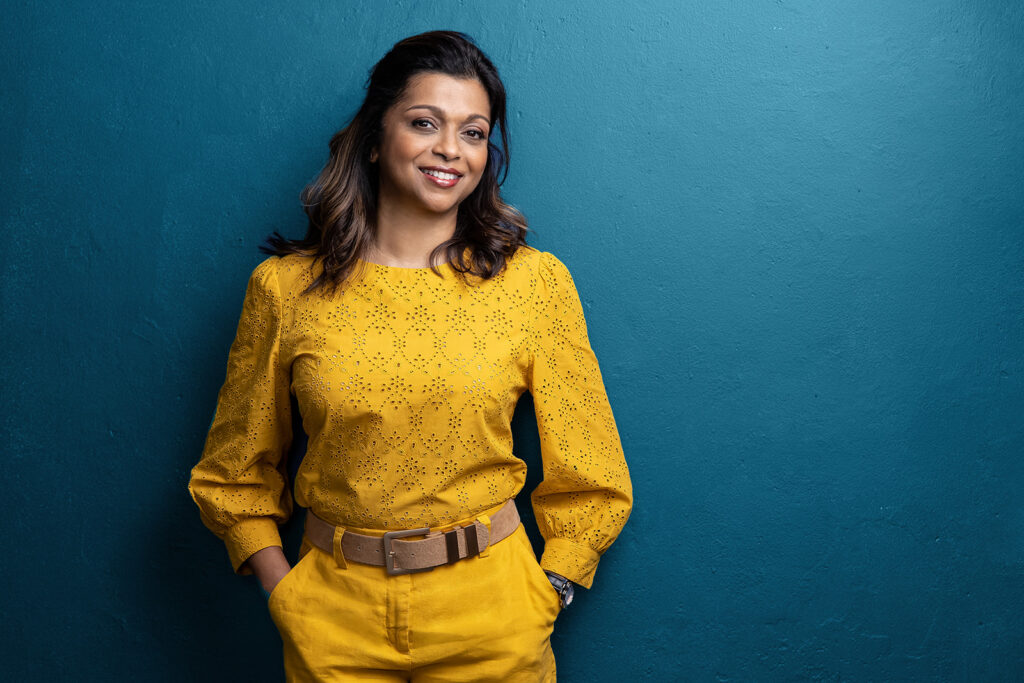


A “full body headshot” is a contradiction in terms. A headshot stops around the shoulders.
But people search for it anyway, and they usually need something simpler than they think. For nearly everything, a headshot does the job. Add a half-body shot when the layout’s wider than it is tall. Save a full-length photo for when the picture has to show all of you, like a real estate signboard, a website banner, a speaker program or a personal brand.
The catch is timing. You can’t widen a photo after the session, so the wider crops have to be planned before you walk in.
What’s the difference between a headshot, a half-body and a full-length photo?
A headshot stops at the upper chest, a half-body at the waist and a full-length at your shoes.
A headshot is the crop people mean when they say “professional photo”, and our guide to headshot framing covers how tight it should be.
A half-body shot, sometimes called a waist-up or mid shot, brings in your arms, your hands and more of your outfit, which gives the picture body language as well as a face.
A full-length photo shows you head to toe, shoes included.
Same person, same light, three very different jobs.
When is a headshot enough?
Almost always.
LinkedIn, the team page, your email signature, Teams, Outlook and industry directories all show your photo small, often as a circle. At that size a wider crop only makes your face smaller, and your face is the whole point. If you shrink a half-body shot to profile-circle size, you can see the problem straight away: it’s mostly jacket. Our headshot size guide covers the dimensions each platform wants.
Think of a lawyer whose photo lives on LinkedIn, the firm’s website and the bottom of every email. That person doesn’t need a full-length photo, and crops they’ll never use aren’t worth paying for.
If your photo only ever appears at profile size, a short headshot-only session is all you need.
When do you need a half-body shot?

You need one when the layout’s wider than your face.
Website banners, about pages with text beside the photo, and speaker programs all have room to fill. Event organisers and designers often crop speaker photos to suit their own layout, so a frame with room around the shoulders gives them something to work with. A tight headshot just leaves them stuck.
Half-body shots also carry personal branding better than a close crop. A consultant leaning slightly forward with relaxed arms says “let’s talk” in a way a face alone can’t quite manage.
For most people, this is the wider crop they’ll actually use.
When does a full-length photo earn its place?
When your whole appearance is part of the message.
Real estate’s the obvious case. Agents commonly appear on signboards, brochures and agency window displays, and those layouts often call for the full figure standing beside a logo or a listing. Our page on real estate agent headshots goes into what agencies usually ask for.
Beyond that, full-length tends to suit people whose brand includes how they stand and dress. That might be a stylist, a speaker promoting a keynote, or a founder whose website has a tall hero image with space for a headline.
If you can’t name where a full-length photo will go, you probably don’t need one.
What changes when you’re photographed full-length?

Everything below the waist suddenly counts.
A headshot forgives a lot, including tracksuit pants, odd socks and the shoes you drove in. A full-length frame shows your shoes, your trouser or hem length, how your clothes fit standing up, your posture and where your hands go. A jacket that looks sharp in a close crop can pull across the middle once you’re standing, and trousers that are slightly too long will bunch at the ankle in every frame.
So wardrobe and posing matter more. Check the whole outfit in a full-length mirror before the day, and bring the shoes you’d wear to meet your best client. Our guide on what to wear for a headshot covers fabrics and colours.
You don’t need to have the posing worked out. A good photographer will direct you, and small adjustments like shifting your weight onto one foot or softening a knee do most of the work.
The space changes too. The standard on-site set needs about 3 m by 4 m, and a full-length frame needs more floor in front of the backdrop, so mention full-length crops before an office shoot.
Can one session cover all three?
Yes, if you ask for it when you book.
Our Elite individual session includes crops from close-up to full-length, and the studios have a range of backdrops, so we can plan the session around the crops you need. Individual sessions run from 20 minutes to 2 hours, and how long yours takes depends on how many crops and outfits you want.
One rule’s worth remembering. A full-length frame can be cropped to the waist later, but a close headshot can’t be widened. If you’ll want both a headshot and a wider shot, ask for each as its own frame.
When the gallery arrives, our guide to choosing your best headshot helps you pick the frames worth keeping.
Want an exact price?
Book a free 15-minute consult – no obligation, just a clear quote and a plan.
How do you keep them consistent with the rest of the team?
Match the headshots first, then add the wider crops.
For a company, the headshot’s the shot everyone needs, and it has to match across the team page. Wider crops are usually only for a few people, such as the leadership team, the agents whose faces go on signboards, or the partners who speak at conferences. Those wider crops should share the same background, light and retouching as the headshots, so the managing director’s banner photo looks like it belongs to the same business as the team page. Mixed, unmatched sets are the most common thing we’re called in to fix, and a wide shot in different light makes the mismatch obvious.
Team images are delivered at 3,000 px on the long edge, with a square crop for directories on request. For ongoing clients we keep the company’s style on file, so new starters can be matched to the existing set. Our page on corporate headshots for companies explains how team days run.
If you’re not sure which crops you’ll actually use, tell us where the photos are going and we’ll suggest what’s worth shooting, even if that’s just a headshot.
Found this useful? Make Hero Shot Photography a preferred source on Google.
Getting your Sydney team photographed?
We run "Staff Headshot Days" - 30+ people, one consistent look, minimal disruption.


